

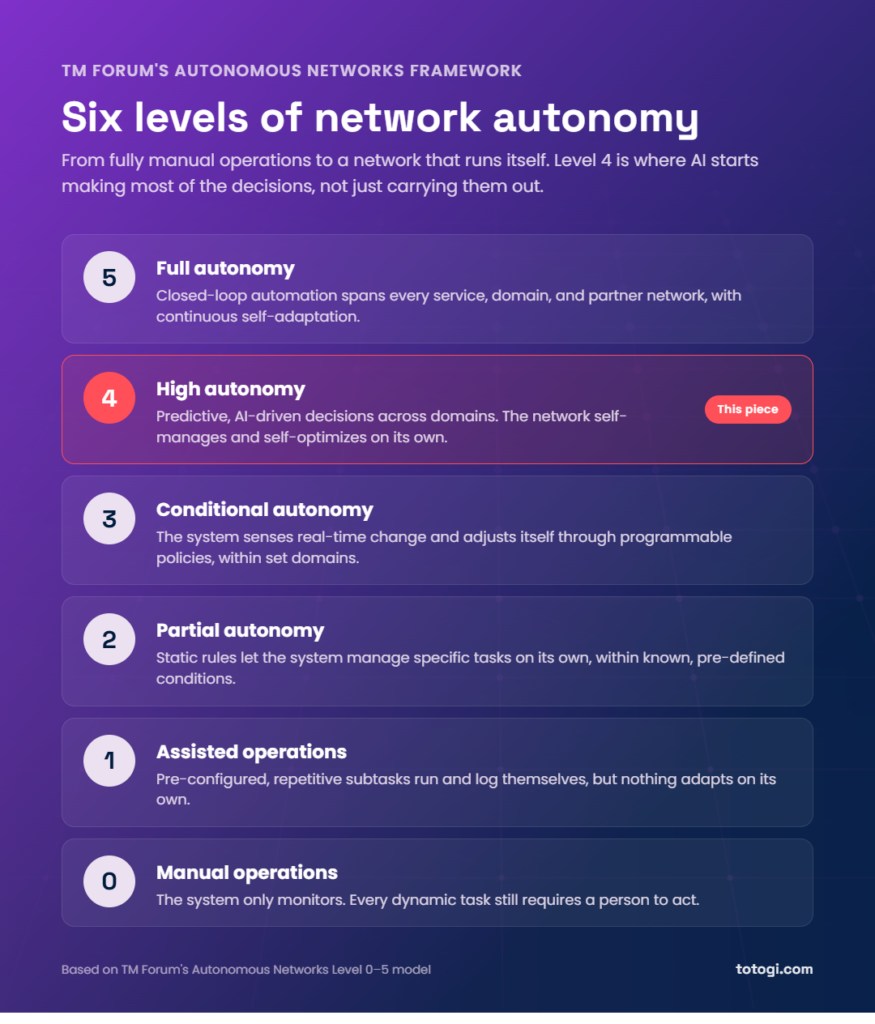
TM Forum’s Autonomous Networks model puts a number on what telecom means by autonomy. Level 4 introduces decision-making based on intent-driven, predictive analysis using AI modeling and continuous learning. It marks a major shift from human-defined automation toward true autonomous decision-making. At Level 4, the network can self-manage, self-optimize, and handle complex tasks. That is not a lab demo. In TM Forum’s 2026 benchmark report on CSP progress toward Level 4, one quarter of 80 operators surveyed worldwide said they expect to reach Level 4 or above by 2027, and 81% by 2030, as reported in TM Forum’s June 2026 Level 4 whitepaper.
We made part of this argument before, in the “Agent orchestration isn’t the hard part. Shared understanding across the telco is” blog post. The point there was decision correctness: an agent needs one accurate model of the estate to reason against before it acts, not a faster way to act on a wrong one. What has moved since that piece is what happens after the agent acts. Across TM Forum’s 2026 publications the emphasis shifts from whether an agent can orchestrate a task to whether an operator can govern it and prove what it did. Past Level 3, that question stops being optional. The operator is no longer the one making most of the decisions.
The governance layer arrived first
An Inform write-up of a TM Forum Catalyst on zero-trust agents for Autonomous Networks names the shift directly, describing the Catalyst’s approach as what it calls an IPOE model:
- Identity, so an operator knows which agent acted
- Policy, so the agent is confined to what it is allowed to do
- Observability, so its behavior can be watched as it happens
- Evidence, so a decision can be reconstructed after the fact
Patricia Díez Muñoz, Global Security Director for Networks & Systems at Telefónica, stated the requirement plainly: “AI agents will only be trusted in telecom operations if operators can verify who is acting, control what is allowed, and prove what actually happened.”
Verizon is already running into the fourth pillar. Describing early experience with agents in network operations, Umashankar Velusamy, the operator’s senior director of network automation technology development, told Light Reading, “Traceability and transparency are key. If there’s a decision that was taken, we need to be able to figure out what was the reasoning behind the decision and what exactly were the decisions.”
TM Forum is already proving something at the industry level, too, and it is worth separating from the agent-level question. In 2025, TDC Net, working with Ericsson, became the first operator to receive a formal, independently audited TM Forum Autonomous Networks Level 4 validation, for RAN energy efficiency optimization, through TM Forum’s ANLAV assessment service and certified third-party evaluators. That validation proves the operator’s autonomy classification is real, not self-declared. It says nothing about whether any single agent’s decision inside that RAN optimization can be reconstructed and proven after the fact, across every system the decision touched. Those are two different kinds of proof. Telecom has built the first one. The second is still open.
Evidence assumes agreement on what happened
Evidence sounds like a logging problem. It stops being one the moment an agent crosses a system boundary, which at Level 4 it does constantly. Take a network-operations agent handling a degraded 5G network slice. It reads the slice’s identifier, the Single Network Slice Selection Assistance Information (S-NSSAI), from the network management system. It checks which commercial service that slice maps to in the catalog, confirms the customer’s SLA credit entitlement in CRM, and applies a remediation: a QoS-priority change plus a service credit in the charging system. In most telco estates, those four systems come from four different vendors, none of whom built for the other three, and reconstructing what happened runs into two different kinds of disagreement.
The first is about nouns. The network layer’s S-NSSAI, the catalog’s service code, and the charging system’s subscription ID may or may not point to the same underlying thing, and nothing forces the three systems to agree. The second is about verbs. The same QoS-priority change that the network layer logs as routine and reversible is, to the charging system, a billable event, and to CRM, a change to what the customer is actually owed. Whether that action was even valid to take, and whether it was the first time or the third for the same incident, depends on a history none of them fully shares. Evidence, in that case, proves an API was called. It does not prove what the call meant, or whether it should have happened at all.
Picture a revenue-assurance analyst asked, six weeks later, why the same SLA credit was applied twice for one incident. The evidence log shows a network agent logging a QoS change against slice SNSSAI-8412, and a service credit posted against catalog service SVC-4471. Three days later, a support agent manually applies a second credit against subscription SUB-99213, for what looks like the same incident. IPOE’s evidence pillar can confirm each of those three events happened, in that order, carried out by an approved actor. It cannot tell the analyst whether SNSSAI-8412, SVC-4471, and SUB-99213 describe the same slice, or whether the second credit was even a valid action given the first one had already happened, because nothing in the governance framework is responsible for knowing either. Today a person reconciles it by hand, the same way revenue-assurance teams already reconcile billing disputes across CRM and charging. At Level 4, with agents acting faster and more often than any team can review, that manual reconciliation is the bottleneck the rest of the architecture was built to remove.
Two patterns dominate how the industry is responding to this, and each falls short for a different reason. The first is bespoke integration, built project by project, which reconciles meaning for exactly the systems that project touched and nothing beyond it. The second, more credible for an executive audience, is agentic AI that works inside a single vendor’s own stack and data model. ServiceNow’s agents reason against its CMDB and Common Service Data Model. Amdocs’s aOS reasons through Cognitive Core, its own telco-verticalized foundation for agentic capabilities. Deutsche Telekom’s MARA takes a third route: every third-party agent has to go through Deutsche Telekom’s own gateway, which requires each vendor to comply with the same standardized guardrails. Global Chief Architect Shekhar Kulkarni describes the mechanism directly: “We ask them to go through our own MCP gateway. We expose these tools.” Each of these gives an operator real evidence inside that vendor’s, or that gateway’s, corner of the estate. None of them gives an operator one shared definition of what a slice is, or what actions are valid to take on it, across the CRM, the catalog, the charging system, and the network domain at the same time. Few operators run all four from a single vendor.
TM Forum has already named the missing piece
TM Forum has named the missing piece itself, in the same June 2026 whitepaper cited above. Agents talk to each other over what it calls the Agent to Agent Protocol for Telecoms (A2A-T). In the whitepaper’s own words, that protocol “can be used to carry the Autonomous Network Common Ontology, ensuring that the terms used during task interactions are assigned the correct semantic meaning.” That is close to a direct statement of this piece’s thesis, and it comes from TM Forum, not from an outside observer.
Read that sentence again, though: the protocol “can be used to carry” the ontology. That is a stated capability, not a claim that any operator has done it across a real, multi-vendor estate. The same section of the whitepaper is candid about why. It names an open-source project, OpenAN, under Linux Foundation Networking. That project aims to support the development and deployment of communication agents, “enabling multi-vendor, cross-domain, and cross-layer system integration.” And it closes by saying the industry’s standards, practices, and open-source work for this protocol “are accelerating, but challenges remain on the path to large-scale commercial deployment.” TM Forum has named the concept. Whether it holds is a different question. A real operator’s network layer, catalog, and charging system come from different vendors with no relationship to each other, and all three still have to agree on what a slice is and which actions on it are valid. That agreement is still inside the challenges TM Forum itself says remain.
Where a telco-specific ontology fits
This is where a telco-specific ontology earns a place, as what evidence needs underneath it rather than as a governance product in its own right. The Totogi Ontology works in three layers. A data layer connects to each system an agent touches, the CRM, the catalog, the charging system, the network core, as they already run. An ontology layer holds the machine-readable model itself: one definition of customer, product, slice, and charge that every one of those systems already maps to, along with the actions each is allowed to take and the conditions under which they are valid. An AI layer of ontology-aware agents reasons and acts against that shared model instead of each agent inventing its own.
An audit trail built on it does not just show that three systems logged three events in sequence. It shows that SNSSAI-8412, SVC-4471, and SUB-99213 describe the same slice, and that a second credit against an incident that already had one is not a valid action. The Totogi Ontology is what makes both “the same” and “valid” checkable facts, instead of assumptions carried by whoever built the integration. The evidence log stops being three artifacts an analyst reconciles by hand and becomes one confirmed, checked sequence, which is what IPOE was supposed to deliver in the first place. A governance framework like IPOE still does the identity and policy work. The Totogi Ontology is what lets the evidence it produces resolve to one story instead of three disconnected ones.
Level 4 autonomy will not stall because operators cannot build guardrails. TM Forum, Deutsche Telekom, Telefónica, and Verizon are already building them. It will stall quietly, in the parts of the estate those guardrails cannot see across. The evidence a governance framework produces is only as trustworthy as the agreement underneath it about what its own words mean. Proving what an agent did is the easy half of the sentence. Proving it holds across every vendor the agent touched is the half still open, and it is worth asking before the industry calls Level 4 solved.
About Totogi: The Totogi Ontology is a governed, machine-readable layer that sits above your CRM, catalog, CPQ, charging, billing, and core systems. It enables AI agents to reason safely and act correctly across your entire operational domain. Learn more at totogi.com.