

Your AI agent aced the proof-of-concept. It routed service requests perfectly in the lab. Then it hit your production environment, tried to amend a CPQ quote while honoring a catalog constraint that contradicted a billing policy, and ground to a halt. Or worse, it proceeded confidently into semantic chaos, creating orphaned transactions that your provisioning team discovered three days later.
This is not a model problem, nor a data problem. This is an architecture problem. And it is the reason most telco AI initiatives are stuck in a long, expensive loop of promising demos and cautious rollouts, while the board asks a reasonable question: when does this start showing up in the P&L?
Every telco running multiple operational systems (CRM, BSS, OSS, catalog, CPQ, charging, core, and many others) knows the friction. When an AI agent or automation workflow has to reason or act across more than one system, it has no machine-readable model of how your business actually works. No governed truth layer. No common language for constraints. It has API documentation and tribal knowledge, and that combination is poison for reliable AI.
The usual first move is to bolt AI onto a specific system. A BSS or OSS vendor ships an AI assistant that works well inside its own stack and data model, and the operator deploys it. That works if your estate is a single-vendor monoculture. In a multi-vendor telco, which is essentially all of them, the agent reasons confidently inside its native domain and falls back to brittle handoffs the moment it has to cross into another vendor’s system. The next move is to build a bespoke integration for each new AI project: connect the agent to the systems it touches, hard-code the business logic, ship it, and hope the pilots stay pilot-scale. Most do not. Six months later, you are running yet another one-off automation that only your senior architect understands and no one else dares to modify.
Where the traditional approach cracks
That pattern has three forces compounding it. First, every AI initiative becomes a custom integration project, because you have never formalized the model of your own operations in a way machines can read and reason over. Second, your operational reality is distributed. A single customer transaction touches six to ten systems, often from different vendors, and none of them speaks the same language. Third, AI agents need context to behave intelligently: what actions are valid now, what constraints apply, what systems can execute what they propose. Without context, they fail silently or execute dangerously.
The result is predictable:
- Pilots succeed in controlled environments with clean data and a single happy path.
- Production reveals that the agent lacks context about constraints it was never taught.
- Manual workarounds and escalation queues grow.
- The business case collapses.
- The team moves on to the next AI initiative with the same architecture.
This is not bad AI engineering. This is what happens when you ask a machine to reason about a domain it has never been formally taught.
A concrete failure: the cross-system care agent
Imagine a telco with a customer care use case: an AI agent that listens to a customer’s request, consults the CRM for account history, checks the 5G core (or the NMS in 4G estates) for network state, queries the catalog for available services, consults the CPQ for pricing, validates feasibility against current subscription terms, and then orchestrates the order. This is a realistic business outcome. Care productivity goes up. First-contact resolution improves. The math works.
Now map the failure path. The agent receives a request to upgrade a customer to a faster plan. It checks the CRM, queries the catalog, runs the CPQ, receives a quote. But the agent does not know that this customer’s subscription contract forbids mid-term upgrades without a penalty. It does not know that the faster plan requires a network capacity reservation that is unavailable in this geography. It does not know that the billing system’s month-end cutoff is in two hours, and orders placed after will break the customer’s invoice cycle.
The agent had no way to know these things. They were never encoded in a way it could access. So it either failed silently, or it offered a solution that created downstream chaos. In production, you caught it. In a live escalation, your customer might not.
The fix is not better prompting or a stronger model, but semantic governance. You need a machine-readable model of how your telco actually works.
Semantic governance, not more middleware
The canonical industry response is integration middleware: more APIs, more data pipelines, more orchestration glue. Telcos have spent billions on this. It works for simple, linear processes. It breaks down the moment an AI agent needs to reason across multiple systems, or when you want to build a second agent that touches the same systems differently. And the math is against you. Point-to-point integrations scale quadratically. Every new system or agent multiplies the pairwise connections you have to build, test, and keep alive. AI capabilities evolve in months; integration projects take quarters and years. Middleware does not close that gap. It widens it.
The real lever is semantic. You need a governed, machine-readable model of your operations that every system can reference and every agent can consult. A data lake stores raw material and is strong for analytics, but it does not encode the actions, constraints, or sequences your business runs on. An API gateway mediates traffic, but it cannot tell an agent what is allowed to happen next, or why. What you need is a model. Something that encodes not just what entities exist, but what actions are valid, what constraints apply, what sequences are allowed, and what each system actually owns and enforces. This is not a knowledge graph for summarization or retrieval-augmented copilots. It is a blueprint for orchestration and validation. Summaries tell an agent what happened. A governed model tells the agent what it is allowed to do next.
AI without context is just automation. Automation with only API knowledge is fragile. But agents grounded in a formal model of your business can reason safely and scale.
Three-layer architecture: how to build a grounded AI platform
Totogi Ontology introduces a three-layer mental model:
The data layer connects to your existing systems (CRM, billing, OSS, catalog, CPQ, core) and extracts real operational truth. Schemas. Configurations. Mappings. Process artifacts. This is not a data warehouse. It is a translation layer that normalizes how your systems represent the same things.
The ontology layer is where the real work happens. A credible telco-specific ontology is not just a richer data model. It has to span three operating dimensions. The semantic dimension defines the core entities of the business and the relationships between them: customers, accounts, subscriptions, services, resources, policies. It tells the system what exists. The kinetic dimension encodes behavior: the actions that can be taken (order, amend, validate, reserve, charge, notify, route), the sequences they must follow, and the constraints that govern them. It tells the system what can happen, and under what conditions. The dynamic dimension is where decisions, constraint evaluation, and learning live. Validity rules answer the question, “Can this agent take this action right now, and if not, why not?” A worked example: “Is a mid-term upgrade permitted for this customer, given their contract terms, the current billing cycle cutoff, and available network capacity in their geography?” The ontology is what makes that a yes-or-no question instead of a human escalation. Most vendor-claimed ontologies stop at the semantic dimension. That is a reference layer. To actually operate the business, the ontology has to be executable across all three.
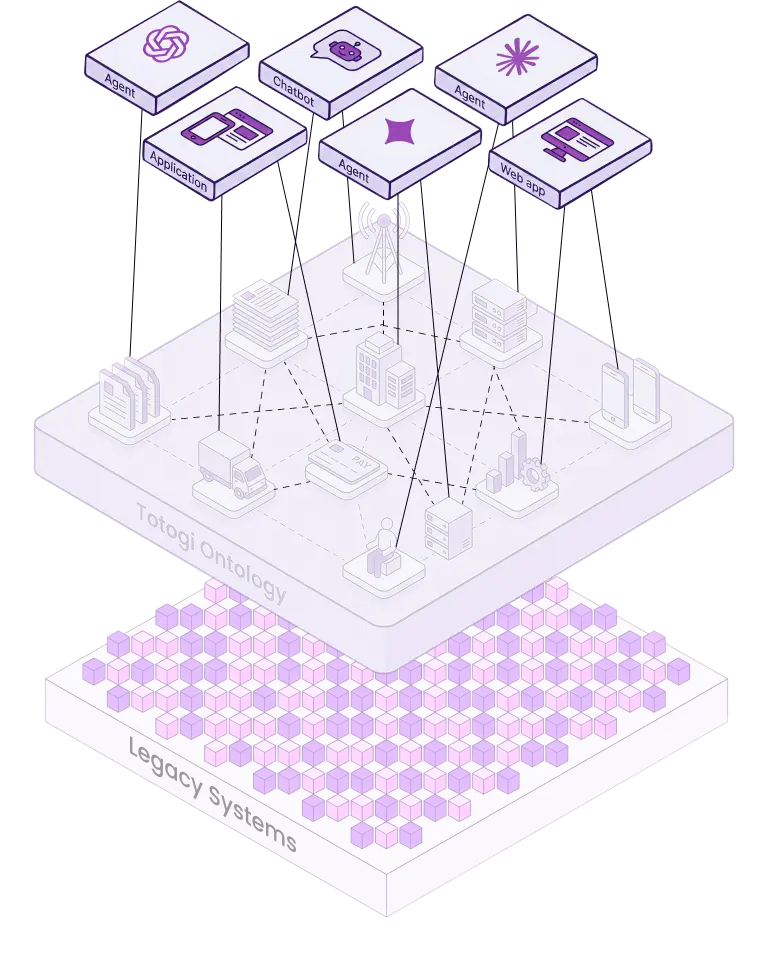
The AI layer sits above the ontology and uses it as ground truth. Any agent, any LLM, any vendor’s AI tooling can plug in. A care assistant, a quote optimizer, a provisioning orchestrator, a network slice modeler, or an agent you have not built yet. All of them query the ontology to understand what they can do, what constraints apply, and what actions will actually work. The ontology is the shared substrate. The agents are interchangeable.
The architecture is deliberately an overlay, not a rip-and-replace. Your existing systems and integrations stay in place. The ontology sits above them and gives every agent, whether a large language model, a traditional RPA tool, or a custom orchestrator, a common and governed way to reason about what your telco can actually do.
What changes
In the care scenario, the agent now has formal access to subscription constraints, network capacity, billing cycles, and catalog dependencies. It queries the ontology before proposing an action. “Can I upgrade this customer?” becomes a yes-or-no question backed by real business rules, not an ambiguous API call.
The quote-to-order flow becomes deterministic. The agent generates a proposal. It validates against constraints in the ontology. It orchestrates the actual transactions across systems. Fewer escalations. Fewer orphaned orders. Fewer manual fixes.
The same approach holds when you layer on the next use case. Consider a post-merger operator running two charging stacks and two CRMs. A one-bill agent has to produce a unified invoice across legacy and acquired accounts, respecting pro-rations, shared-minute pools, loyalty credits, and tenant-specific promotions. Without a governed model, it is another bespoke integration with its own rules engine. With the ontology already encoding customer identity, product structure, and charging semantics, the one-bill agent draws on the same foundation the care agent does. Same constraints, same action vocabulary, same validity checks. You build agent logic on a reusable substrate, not a new substrate each time.
The same math applies to MVNO onboarding, network slice monetization, and every AI use case that comes after. You encode the business rules once, in the ontology. Every new agent inherits the context. You ship agent logic, not integration and constraint logic. Weeks, not months.
The telco gets reusable intelligence. One ontology. Many agents. One source of truth for how your business works, accessible to every tool, every process, every team.
The realistic outcome
This solves one of the biggest problems telcos face when scaling AI: the context and execution gap. It makes AI safe to deploy across systems and collapses the feedback loop between “demo works” and “production fails.” Your AI initiatives scale beyond one-off integrations.
Your existing systems stay. Your teams stay. The friction goes away.
About Totogi: Totogi Ontology is a governed, machine-readable layer that sits above your BSS, OSS, and core systems. It enables AI agents to reason safely and act correctly across your entire operational domain. Learn more at totogi.com.